How do you tell if a town has actually changed, or if it just got loud for one weekend and went quiet again?
Canton just answered that question twice in the same summer, and most people only noticed the louder answer. The 118th Canton Labor Day Festival wrapped up this Monday, September 7, with Dailey & Vincent closing out a weekend that opened with Clay Walker on Sunday night at Sorrells Street Park. It is, by a wide margin, the oldest Labor Day celebration in North Carolina and the rest of the South, dating back to 1906. That kind of longevity is worth something. It also tells you almost nothing about where Canton is headed, because a tradition that has survived 118 years is, by definition, not the part of town that's changing.
The part that's changing is three years old, tucked into a gravel lot on East Main Street, and buried in a land deal about a wastewater plant. If you want to know what downtown Canton looks like in five years, that's where to look.
A Festival That's 118 and a River Party That's 3
Set the two side by side and the contrast does the explaining for you.
| Labor Day Festival | Pigeon RiverFest | |
|---|---|---|
| First held | 1906 | 2024 (3rd annual in 2026) |
| Location | Sorrells Street Park | Canton Recreation Park and Current Tavern |
| 2026 headliners | Clay Walker, Dailey & Vincent | Local vendors and river-focused programming |
| What it tells you | Canton keeps a promise | Canton is testing something new |
The Labor Day Festival is an institution. It runs on muscle memory: the same park, the same holiday weekend, a headliner slot that's been filled by a country star or bluegrass act for over a century. That reliability is exactly why it's a poor indicator of change. Institutions don't need to prove anything. They just show up.
Pigeon RiverFest, held this year on August 22 at Canton Recreation Park and Current Tavern, is doing the opposite. It's in its third year, which means the town is still figuring out whether it sticks. A festival built around the river, rather than the mill or the holiday calendar, is a small but real signal that Canton's civic identity is shifting away from the smokestack that used to define the skyline and toward the water that runs past it. Three years isn't proof. It's a data point. But it's the kind of data point that a century-old festival can't give you, because a century-old festival already answered its own question a long time ago.
What a Gravel Lot on Main Street Can Tell You
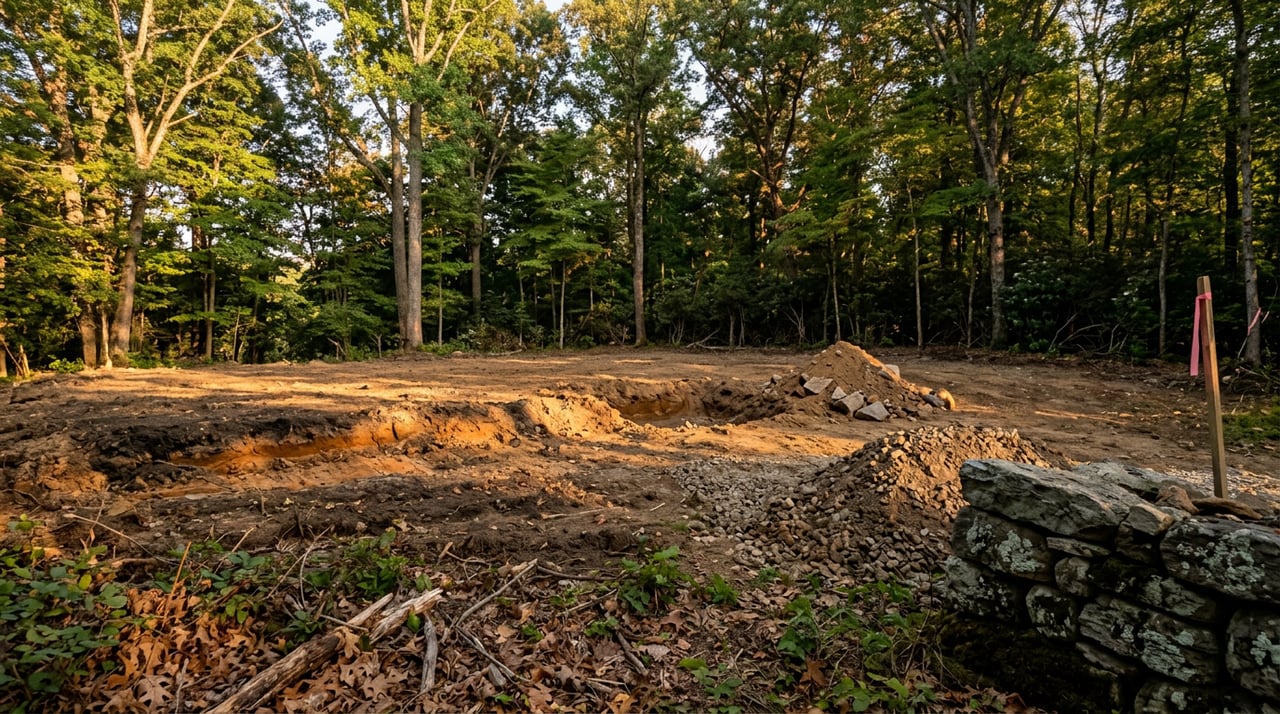
The clearer test case sits between two businesses that already exist: The Dry Social and Providence Insurance, on a 0.212-acre gravel lot across from Mamma Onesta's Italian Restaurant. Earlier this year, a developer called ForrPlaces Development LLC asked the Canton City Council for a conditional use permit to put a four-story mixed-use building there. The plan calls for 5,000 square feet of retail or restaurant space at street level, 15,000 square feet of residential space across two floors, rooftop penthouse units, and a parking garage.
The council held a public hearing on June 4 and had a vote scheduled for July 2. In the developer's letter of intent to the city, the stated goal was straightforward:
"introduce residential infill within the downtown core to support existing businesses and enhance overall economic activity"
That sentence matters more than the square footage. Canton's Central Business District zoning means the commercial portion of that lot could be built regardless of how the residential permit shakes out. The real question the council was weighing wasn't whether something gets built on that gravel lot. It was whether Canton wants people living above its shops on Main Street, not just shopping and eating there. A downtown that adds rooftop apartments over retail is a downtown betting on foot traffic that starts at 7 a.m. and doesn't end when the restaurants close. That's a different kind of Main Street than the one built around a Labor Day weekend and quiet the other 363 days.
The Slower, Bigger Move: Water
The infill project is the visible test case. The water deal is the one that makes the infill project possible at all, and it moves on a much longer clock.
When Pactiv Evergreen closed the paper mill in 2023, Canton lost more than its largest employer. For decades, the mill's treatment plant had handled both industrial and municipal wastewater, which meant the town's sewage treatment was effectively subsidized by mill operations. When the mill shut down, Canton found itself depending on a privately owned facility for a service that used to come nearly free.
The town's response has been to buy its way back to control. Canton is purchasing roughly 52 acres on the west side of the Pigeon River from Two Banks, in two phases. The first piece, a chip yard and warehouse parcel of about 26 acres, was set to close by late March 2026 and will become the site of a new municipal wastewater treatment plant designed to handle at least 2 million gallons per day. The second piece, the existing wastewater treatment plant parcel, closes by 2031, once the new facility is operational and the old one can be decommissioned. The whole deal is funded through state appropriations rather than local tax dollars.
This is not a glamorous headline. No one is going to put "new wastewater plant" on a festival poster. But it's the infrastructure that has to exist before anything else on that old mill footprint can get built, and before downtown can absorb more residential density without straining a system that used to run on someone else's dime. The gravel lot on Main Street and the 52 acres by the river are the same story told at two different speeds. One is a building permit decided in a matter of weeks. The other is a public utility decision that plays out over most of a decade. Both start from the same premise: Canton is planning for people who don't just visit for Labor Day weekend, they stay.
What's Actually Open This Week
None of that changes what's worth doing downtown right now, which is still the more useful question if you already live here.
BearWaters Brewery, a family-owned operation on the Pigeon River a short walk from Main Street, is still the easiest answer for a Friday evening, whether you're there for the beer list or the trivia night on the patio overlooking the water. The Southern Porch, housed in the 1876 Imperial Hotel building, remains the closest thing downtown has to a landmark meal, serving fried green tomatoes and shrimp and grits inside a Queen Anne structure that started life as a private home. The Grateful Table covers the other end of the day, with locally sourced breakfast, lunch, and grab-and-go options for anyone who doesn't have time to sit down. And Willow Hill Soap Company, one of only three soap shops in Haywood County, still makes everything by hand in the back of its own store.
The Pigeon River Scenic Walking Trail, a 1.5-mile stretch with benches and a boat ramp connecting downtown to the river, is worth the walk regardless of the season, and Pickin' in the Park, the Friday-night bluegrass series at Canton Recreation Park, has carried the summer's live music before the festival ever started and will likely close it out before the leaves fully turn.
The festival made the noise. The gravel lot, the river deal, and the third annual RiverFest are making the actual decisions. If you're watching Canton to understand where it's going rather than where it's been, the quieter stories are the ones to keep an eye on.
Kim Gentry Justus has spent years watching towns like Canton change from the inside, one permit and one property at a time, and Asheville Land & Luxury tracks these shifts across Western North Carolina long before they show up in a listing. If you're curious what a moment like this means for property in Canton or anywhere else in the region, connect for a curated consultation.