Two listing sites will tell you the average acre of land in Madison County costs two very different amounts. One puts the number at $36,490. Another puts the median at $13,816. Both are current. Both are technically correct. And neither one tells you what the three-acre parcel you're actually looking at should cost.
That gap of nearly three times isn't a data error. It's the whole story, and it's the first thing worth understanding before you make an offer on anything near Marshall.
The Number Everyone Quotes, and the One That Actually Moves
When a buyer searches "Madison County land price per acre," the headline figure that surfaces is usually an average built from every active listing, small homesites and sprawling tracts lumped together. As of recent listing data, that average sits at $36,490 an acre across roughly 1,791 acres of active inventory. A separate source calculates a median of $13,816 an acre. Land.com also reports that its typical listed lot runs about 57 acres for a total price near $719,148, which works out to roughly $12,617 an acre once you do the division, a figure that lines up closely with that lower median.
The pattern underneath both numbers is well documented in land economics: small parcels command a steep premium per acre, and large tracts get a bulk discount. A one to five acre homesite can run well above the local average, while a hundred-acre block often sells for less per acre because the fixed costs of surveying, road access, and utility hookups spread across more ground. Buyers can also usually only afford a five or ten acre parcel where they'd need serious capital for a 300-acre one, which keeps demand and prices elevated at the small end.
Madison County's own numbers back this up. Farmland listings there average $35,076 an acre, close to the overall average of $36,490, because most farm tracts for sale are mid-sized working parcels rather than tiny homesites. But the smallest "cheap land" listings, averaging under $38,000 total, actually price out around $6,529 an acre, showing that the market segments by size more than by any single county-wide rate. If your parcel is three acres, the county average is nearly meaningless. If it's sixty, it might undersell what a comparable smaller tract would command.
| What's being measured | Reported figure | What it implies |
|---|---|---|
| All active Madison County land listings (avg) | $36,490 per acre | Skewed upward by small, high-demand parcels |
| Madison County farmland listings (avg) | $35,076 per acre | Mid-sized working tracts, closer to the county average |
| Typical Land.com lot (57 acres, ~$719,148 total) | ≈ $12,617 per acre | Larger tracts pulling toward the lower median |
| County-wide median per acre | $13,816 per acre | The size distribution, not a flat market rate |
The takeaway for a buyer comparing two listings side by side isn't which per-acre price looks lower. It's whether the parcels are even the same size class. Comparing a 2-acre gated-community lot to a 40-acre wooded tract by per-acre price alone is like comparing the unit price of a single apple to a case of them.
Why the Same Ridge Prices Two Ways
Part of this comes down to what a seller can actually do with a large holding. Splitting a bigger tract into smaller parcels means new surveys, zoning review, and often new road or utility work, all of which adds cost that gets passed forward into the per-acre price of the resulting small lots. A seller sitting on 300 acres with limited road frontage also has less incentive to carve off two or three acres and lose access for the rest of the tract, which keeps small parcel supply tight relative to demand.
None of this is unique to western North Carolina. It shows up in land markets nationally. What makes it worth understanding here specifically is that Madison County's terrain adds a second variable that often matters more than size: whether the ground under a given building envelope can actually support a house.
The Question That Actually Sets the Price
Western North Carolina counties, Madison among them, are flagged as some of the most difficult in the state for septic feasibility. Shallow bedrock, sometimes only 18 to 24 inches below the surface, rules out conventional septic systems on a meaningful share of mountain lots. Slopes steeper than 15 percent push a buildable site toward low-pressure pipe or drip irrigation systems, both considerably more expensive than a standard drain field. A parcel can look ideal from the road and still fail the one test that determines whether you can legally build on it.
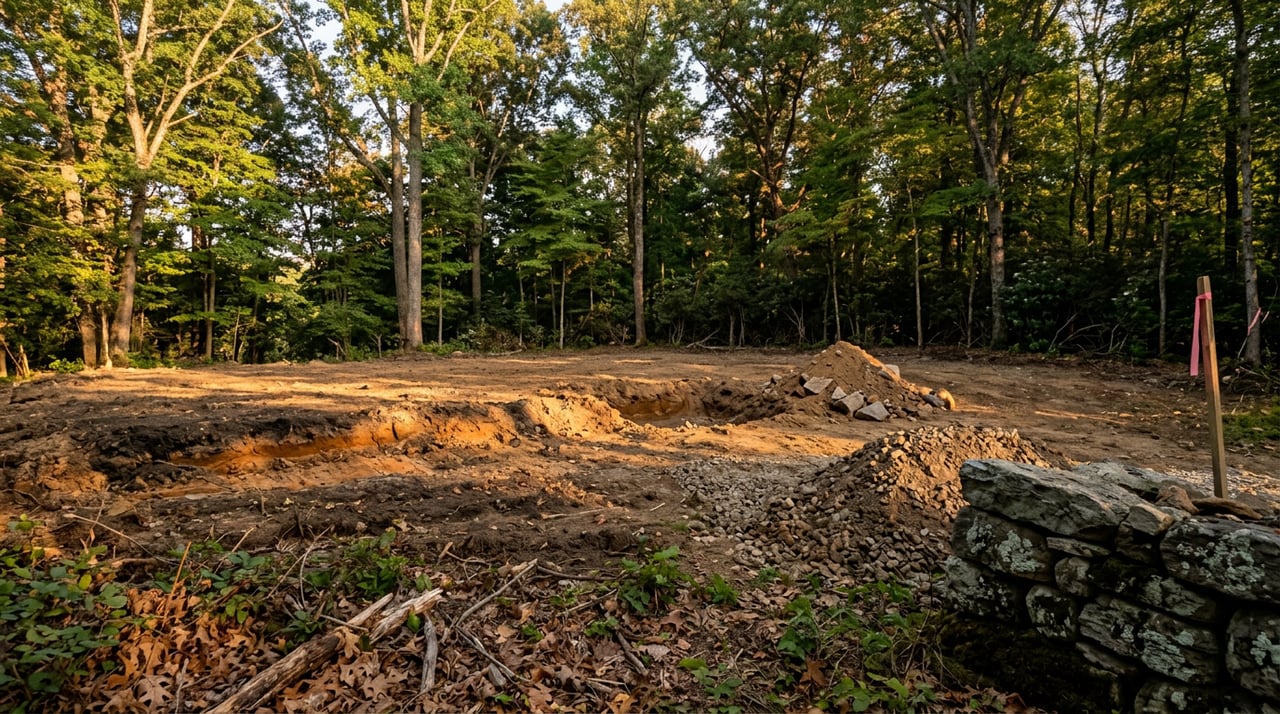
North Carolina no longer relies on the old-style perc test, where an evaluator poured water into a hole and timed the drainage. The state now uses a soil morphology evaluation, where a licensed evaluator digs several test pits and examines texture, structure, color, and depth to bedrock and to the seasonal water table. Gray mottling in the soil, for instance, signals seasonal wetness that can complicate or block a conventional system. The classification that comes out of this evaluation is the single biggest factor in what your septic system will cost to install, not the acreage on the deed.
If a property already has an active Improvement Permit, that's meaningful. In Madison County, these permits are valid for 60 months from issue. A permit from a few years ago that's still inside that window means someone already did the legwork, though it's worth confirming the site conditions haven't changed since, particularly if there's been nearby grading or construction. If the permit has lapsed, a new evaluation is required and the results aren't guaranteed to match the original.
There's also a workaround worth knowing about if a parcel's own soil doesn't cooperate. Madison County's environmental health program allows septic easements onto a neighboring tract when the primary lot can't support a system on its own soil or lacks the space to meet setback requirements. That process requires the neighboring owner's cooperation, a surveyed easement area, and an attorney-drafted agreement recorded on the deed, all before the county will issue authorization to build. It's a real option, but it depends entirely on a willing neighbor, which is not something a buyer should assume into a purchase timeline.
What This Looks Like in Madison County's Actual Listings
Walk this logic through the communities that actually show up in current Madison County inventory and the pattern gets concrete. Bear River Lodge, a gated 320-acre community bordering Big Laurel Creek within the Pisgah National Forest a few miles from Hot Springs, lists lots as small as two acres alongside larger parcels, and the smaller lots aren't discounted for their size the way a raw, unimproved 2-acre tract elsewhere might be. That's because buyers there are paying for walkable, maintained roads and a settled gated community, not just dirt.
Seven Glens tells a similar story from a different angle. Part of the community sits in Madison County and part in Buncombe, and the Madison County section carries lower property taxes than its Buncombe counterpart even though the lots share the same paved, HOA-maintained road system. One listing there noted a well already in place on the lot, a detail that matters more to final cost than the acreage itself, since it removes one of the biggest unknowns a buyer would otherwise have to test for.
French Broad Crossing, a riverfront gated community in Marshall, and Mountain Meadows, a Green Built community organized around a shared garden and lodge, both draw premiums tied to amenities and stewardship standards rather than sheer size. None of these are the raw 50-plus acre tracts where per-acre price drops toward the county's lower median. They're small, improved, access-ready parcels, which is exactly the segment where the small-parcel premium shows up most clearly.
Reading the Broader Market Right Now
For context, the resale home market in Marshall has cooled some this year. As of September 2026, homes in Marshall carried a median list price of $500,000, down 7 percent from a year earlier, with price per square foot down 11 percent over the same period and days on market falling to 147, a 14 percent drop year over year. That's a softer, slower-moving home market than the wider region, though it describes finished houses, not raw land, which behaves on its own timeline shaped by soil conditions, access, and the size dynamics above rather than by the same seasonal buying patterns.
For a land buyer, that broader softness means less competitive pressure to skip due diligence. Take the time. Ask for the Improvement Permit and its issue date. Ask whether the access road is deeded or an easement, and whether it's maintained by an HOA or by whoever gets around to it. A parcel that looks like a bargain on a per-acre basis can turn into the most expensive purchase in the county once an alternative septic system and a private road become part of the build budget.
A Few Questions Worth Asking Before You Tour
Does North Carolina still use a perc test? Not in the old sense. The state now requires a soil morphology evaluation, where a licensed evaluator digs test pits and classifies the soil by texture, structure, color, and depth to bedrock and the water table, a more permanent read on buildability than a single-day drainage test.
How long is a septic Improvement Permit good for in Madison County? Sixty months from the date of issue. A permit still inside that window is a real asset on a listing, though it's worth confirming nothing has changed on site since it was granted.
What if the parcel I want doesn't perc? An alternative system such as low-pressure pipe or drip irrigation may still make the site buildable at higher cost, or the county's process allows a septic easement onto a neighboring tract if that owner agrees and the area is properly surveyed and recorded.
Land in Madison County rewards buyers who ask the second question, not just the first. The per-acre price on a listing tells you where a parcel sits in the market's size distribution. It doesn't tell you what's underneath it, or what a small lot's paved access and existing well are quietly worth.
If you're weighing acreage near Marshall, Hot Springs, or anywhere else in Madison County, Asheville Land & Luxury can walk the terrain with you, both figuratively and literally, before you're under contract. Connect for a curated consultation and we'll help you read a listing the way the land itself reads.